
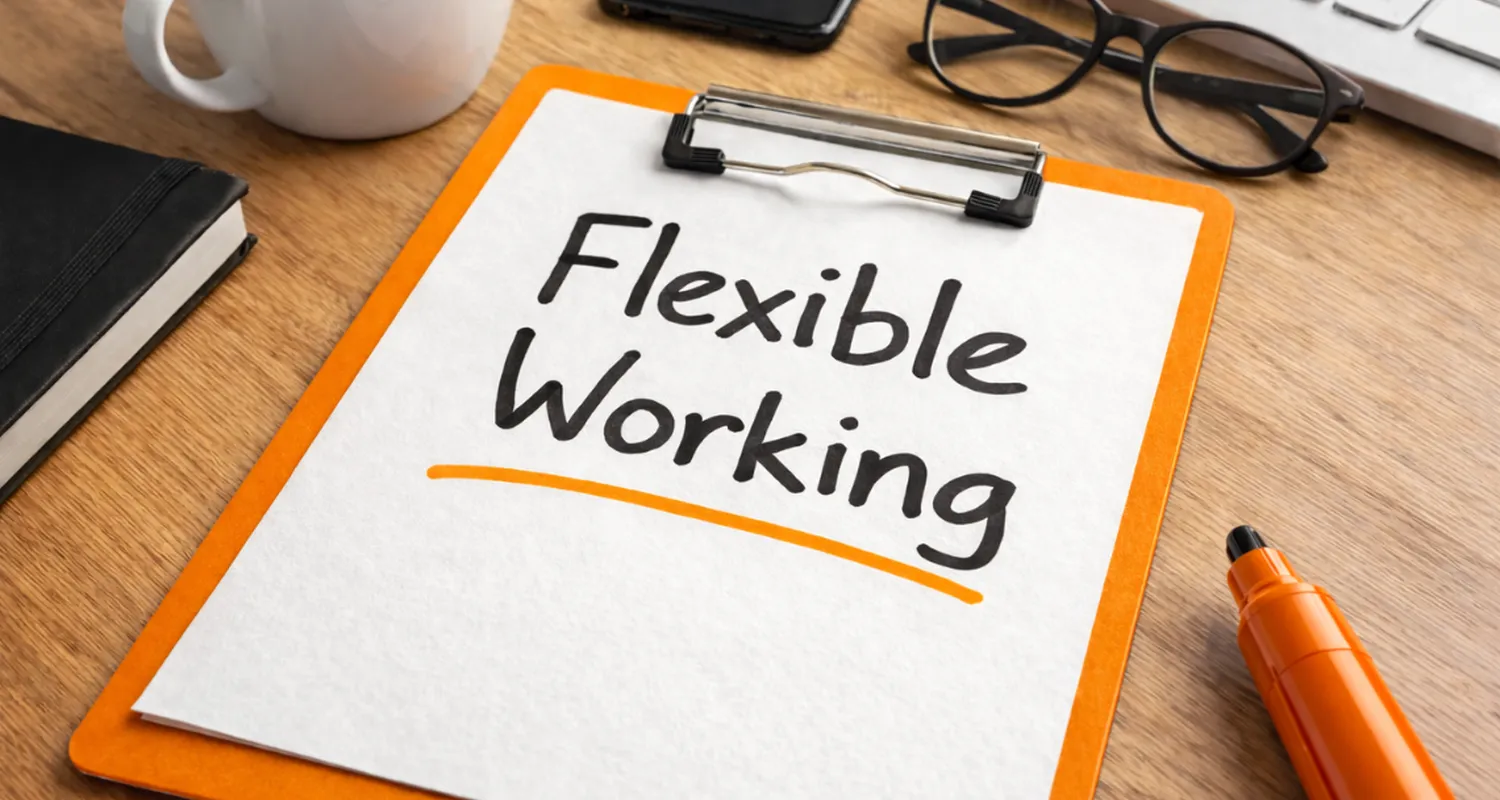
Flexible work is no longer defined by location, but by how work is designed and experienced.
Today, the question is no longer just where work happens—that’s often the most visible, but not the most decisive layer. What matters is the quality of the employee experience: autonomy over routines, predictability of schedules, the ability to organise time, adjust workflows and operate with clear expectations. Flexibility is no longer a single concept, but a set of factors shaping how work is designed.
This shift is reflected in both business discussions and recent research, showing that more mature organisations are moving beyond location to focus on designing work for value, and that flexibility and work–life balance have become essential for many professionals, particularly in attracting talent and driving satisfaction and retention.
Why flexible work is evolving

The concept has matured because professional life has become more heterogeneous. People experience work differently and face varying constraints across life stages, meaning two individuals may both want “flexibility” but mean very different things. For some, it’s predictability and reduced friction; for others, autonomy over time, learning opportunities, or stability in structured roles.
Gallup reinforces this shift, showing that work quality depends not just on hours, but on predictability, stability, and control. In 2025, it reported that 62% of workers lack high-quality schedules, which are strongly linked to better financial security, work–life balance, and job satisfaction.
This reframes the debate: the opposite of flexibility is no longer physical presence, but poorly designed rigidity—which can exist in both office and remote environments.
Why flexible work is more than remote or hybrid work
Many companies still operate with a simplified logic: they assume that offering a hybrid work model or some degree of remote work automatically meets talent expectations. It does not.
The real opportunity lies not in where work happens, but in how it is designed. Organisations with hybrid work models can still feel rigid, while predominantly on-site models may offer high levels of autonomy—the difference is in the design.
Remote work, for example, quickly loses its sense of flexibility when paired with excessive meetings, constant interruptions, unclear schedules, and expectations of continuous availability. Conversely, on-site models can be perceived as effective—and even desirable—when they provide predictability, clarity and genuine control over time.
This is why the debate has evolved. Professionals are no longer evaluating visible benefits, but the quality of the experience a work model creates.
What professionals value in flexible work today
Generic policies have lost traction because the value of flexibility varies by context, career stage, role and personal circumstances.
For professionals in transition, flexibility has become a compatibility criterion
Those in transition tend to assess flexibility more critically. It is no longer enough to know whether a role is remote or hybrid—the focus shifts to how work is structured: autonomy, predictability, trust, and whether the model supports sustainable performance or continuous availability. This aligns with the idea of more fluid, less linear career paths.

For many workers, stability matters as much as freedom
A common misconception is that all professionals seek maximum autonomy. In many cases, what matters more is predictability. Deloitte highlighted this tension in 2025: while organisations move toward more agile models, many workers still prefer stability. Mature flexibility, therefore, is not the absence of structure, but well-designed structure with room for adaptation.
For companies, the challenge is calibration, not just granting flexibility
From an employer perspective, simplistic policies often fail to resonate with diverse talent pools. Treating flexibility as a uniform benefit overlooks varying preferences and the importance of alignment between individual, role, leadership, and organisational design.
Kestria’s study on remote leadership reinforces this gap: only 11.71% of organisations offer schedule autonomy, while 29.27% of employees prefer it, and 54.15% report access to flexible hours. This suggests a mismatch between what is offered, what is perceived as desirable, and what actually creates a compelling work experience.
Flexible work as work design
When properly understood, flexibility extends beyond location to encompass how work is structured. It can be viewed across four key dimensions:
- Autonomy over time
Not just where work happens, but the ability to organise focus time, peak productivity periods, and daily routines without penalty. - Predictability
In many contexts, predictability matters as much as freedom. Professionals value schedules that are clear, stable, and respectful. - Workflow design
Flexibility often breaks down when workflows are built on constant urgency, overlapping meetings, poor prioritisation, and continuous availability. In such cases, policy and experience diverge. - Sustainable rhythm
Increasingly, flexibility is tied to cognitive and psychological sustainability—enabling work with less friction, greater focus, and lower exhaustion.
This perspective aligns with broader future work trends, where flexibility is becoming a core design principle. Microsoft, through its Work Trend Index, emphasises that work is no longer just a place but an experience that must transcend time and space, highlighting the importance of flexibility, adequate resources, and decision-making autonomy in shaping that experience.
Common mistakes in flexible work design
The most common mistake is confusing policy with perception. A company may adopt a hybrid model and still be experienced as rigid, offer flexible hours while penalising delayed responses, or promote autonomy while operating through control, surveillance, or micromanagement. Flexibility does not thrive in low-trust cultures.
Another misstep is assuming the issue can be solved with a single model across the organisation. In complex environments, this rarely works—roles, seniority levels, and work types vary too much for one approach to remain effective.
A more mature path is not choosing between uniformity and complete freedom but defining clear criteria: which roles require synchronous presence, which allow greater autonomy, which leaders can manage by outcomes, and where predictability or schedule flexibility creates real value.
How to assess flexible work opportunities
For professionals assessing opportunities, flexibility requires a more sophisticated lens. Accepting or rejecting a role based solely on whether it is remote, hybrid, or on-site is often insufficient. The more relevant questions are how work is structured: how schedules and priorities are managed, whether there is clarity around deliverables and autonomy, whether leadership operates with trust or control, and whether the model is sustainable over time. Just as important is the alignment between the stated flexibility and the day-to-day experience. These factors distinguish organisations that have merely adopted policies from those that have learned to design work more effectively.
More broadly, the conversation on flexibility has matured alongside the increasing complexity of work itself. What once appeared to be a question of location is now a broader shift toward flexible work beyond remote work, encompassing autonomy, predictability, trust, rhythm and the overall design of the employee experience. As a result, professionals evaluate flexibility differently—recognising that its quality depends less on where work happens and more on how it is structured.
For organisations, this shift is equally significant. Simplistic approaches to flexibility often weaken alignment with diverse talent and result in policies that appear modern but fail in practice. A more mature approach requires moving beyond labels and focusing on the underlying architecture of work. Without this shift, companies risk losing effectiveness in attracting, retaining and engaging talent, while professionals risk mistaking short-term convenience for long-term compatibility.